Shadow AI and the Governance Gap: What Leaders Must Do Now
Contributors


Across industries, employees are quietly embracing generative and agentic AI to work faster and smarter, using chatbots to draft content, summarize data, and even code through “vibe coding.”
A recent KPMG study reveals that 58% of employees now use AI tools daily, often because they outperform enterprise systems. But speed without oversight creates exposure. Nearly half admit to uploading sensitive company data to unauthorized platforms. What began as a productivity boost is quickly becoming a hidden security threat operating inside the firewall.
Potential Security Threats Executives Should Not Ignore
Shadow AI does not attack from the outside; it emerges quietly within enterprise workflows, making it especially dangerous Below are the most pressing threats organizations face today:
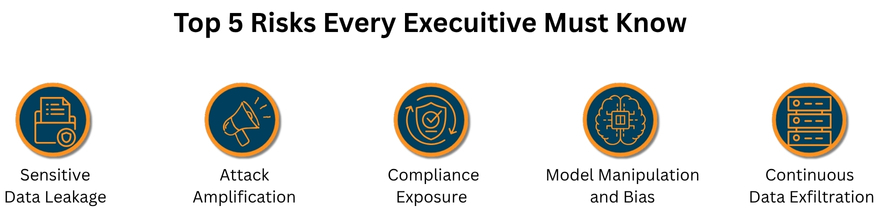
Sensitive Data Leakage and Exposure
Employees often paste confidential information, customer details, codes, and strategy documents into public AI tools. That data may be retained by third-party systems, creating irreversible exposure with no audit trail.AI-Powered Attack Amplification
Leaked outputs from unsanctioned AI use can be repurposed by adversaries to design far more convincing attacks. Threat actors can build tailored phishing, voice, or video impersonations and social-engineering schemes that closely mirror an organization’s tone and procedures, which increases the likelihood of successful compromise.Compliance Violations
Shadow AI can breach data privacy laws such as GDPR, HIPAA, or SOC 2. Because these tools operate outside corporate compliance frameworks, they bypass consent, retention, and auditing controls.
Model Manipulation and Bias Risks
Unverified AI models can generate inaccurate, biased, or misleading outputs that influence decisions, from HR screening to financial projections. Without governance, these models can quietly distort operations.Data Exfiltration at Scale
Shadow AI does not just leak data; it learns from it. Each prompt containing proprietary details reveals how teams work, decide, and think. Over time, these interactions can expose an organization’s logic, strategy, and IP, creating a continuous flow of insight leaving the enterprise without detection.These risks are no longer theoretical; they represent an evolving cyber threat vector that traditional controls cannot detect or mitigate.
The Hidden Cost of Unchecked AI Use
The danger of Shadow AI extends beyond cost exposure; it is a governance gap that undermines trust and accountability.
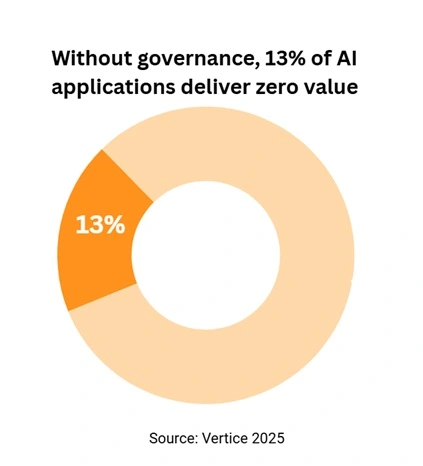
AI models trained on uncontrolled data can produce outputs that distort business logic or introduce regulatory violations. Worse, when AI operates outside enterprise oversight, compliance teams lose visibility into data lineage, model reliability, and decision integrity.
Unverified external servers may store a single query containing sensitive information indefinitely, thereby exposing the organization to financial, legal, and reputational risk.
In the era of accelerated AI adoption, an unmanaged AI ecosystem has become the new insider threat.
Building a Governance Model for Shadow AI
Employees use unapproved AI tools to solve real problems, not to bypass policy. Forward-thinking leaders can transform this behavior into a managed advantage.
Build secure AI sandboxes where teams can safely experiment using anonymized or synthetic data. Deploy AI-aware data loss prevention (DLP) and cloud access security broker (CASB) solutions to improve visibility. Classify tools as approved, restricted, or prohibited based on assessed risk.
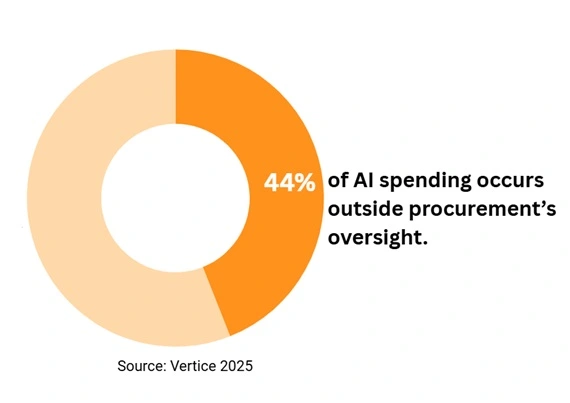
Shift the mindset from enforcement to enablement by promoting transparency, open reporting, and continuous training. Learn from employee innovation patterns to accelerate enterprise AI adoption securely.
Shadow AI cannot be eliminated, but it can be governed. Effective governance is not restriction; it is about creating guardrails where innovation can thrive responsibly.
Leadership’s Role: From Awareness to Action
For today’s C-suite, Shadow AI is not just a technical challenge; it is a strategic and cultural one.
Every decision carries a digital dependency, and every digital process leaves an AI footprint. Whether an organization embraces AI or hesitates, the risks already live within its workflows.
Leaders must guide the shift from “move fast” to “move smart.”
That means fostering innovation while enforcing ethical, transparent, and compliant use of AI. The strongest AI-driven enterprises will be those that govern innovation well, not those that simply adopt it first.
The Next Step: Enable Innovation Without the Shadow AI
The rise of Shadow AI marks a pivotal moment in enterprise governance.
If left unchecked, it can undermine compliance, trust, and data integrity.
If governed effectively, it becomes a powerful catalyst for secure, compliant, and scalable innovation.
To help business leaders balance control with creativity, DivIHN Integration, Inc. invites you to an exclusive webinar:
“Enable Innovation Without the Shadow AI”
Join industry experts and technology leaders as they share actionable strategies for governing AI responsibly, protecting data, and accelerating enterprise innovation through secure, managed adoption.
Date: Thursday, November 13, 2025
Time: 11:00 AM to 12:00 PM CT



Popular Articles
In the digital age, businesses must adopt an ad
GRC is the capability, or integrated collection
Get the latest insights straight from our desk to your inbox.
Featured Articles
Explore more →
Whitepaper: Ransomware Threat Management
Ransomware continues to be a real threat to business operations across all industries, no organization is safe from this threat.
Laszlo S. Gonc
CISSP, First Senior Fellow, DivIHN Cybersecurity Center of Excellence view
Cybersecurity Incident Response Preparedness
An incident response framework provides a structure to support incident response operations. A framework typically provides guidance on what needs to be done, but not on how it is done.
Laszlo S. Gonc
CISSP, First Senior Fellow, DivIHN Cybersecurity Center of Excellence view
IoT Medical Device Cybersecurity
Healthcare data and medical devices would be aggressively targeted by ransomware attacks since early 2017 has proven to be true