How Citation-Backed Conversational AI Improves Public Access and Internal Decision-Making

“Numerous citations to studies that do not exist.”
That is what auditors have found when reviewing AI-generated legal and policy summaries.
Government agencies, law firms, and compliance teams cannot rely on answers that sound correct but cannot be verified. Dense statutes and layered regulations demand traceability, not just fluency.
That tension creates risk.
- Internal misinterpretation slows decisions.
- Oversimplified public explanations erode trust.
- AI answers without traceable sources multiply the danger.
The real issue isn’t whether AI can summarize a statute. It’s whether the answer can be defended.
The Trust Problem in Legal AI
Most generative AI systems are built for fluency, not accountability. They produce confident responses that sound correct. But in legal, regulatory, and public sector environments, sounding correct is not enough.
An answer must be verifiable. If a system cannot point to the exact statutory clause, regulatory subsection, or policy paragraph that supports its claim, the output is not decision-grade. It becomes an opinion wrapped in confident language.
- For government agencies, that is unacceptable.
- For law firms and lobby firms, it is liability.
- For legal nonprofits, it undermines advocacy credibility.
Trust is not created by tone. Trust is created by traceability.
What Citation-Backed Conversational AI Actually Means
Citation backed AI is not just “adding a link.” It’s an architectural commitment.
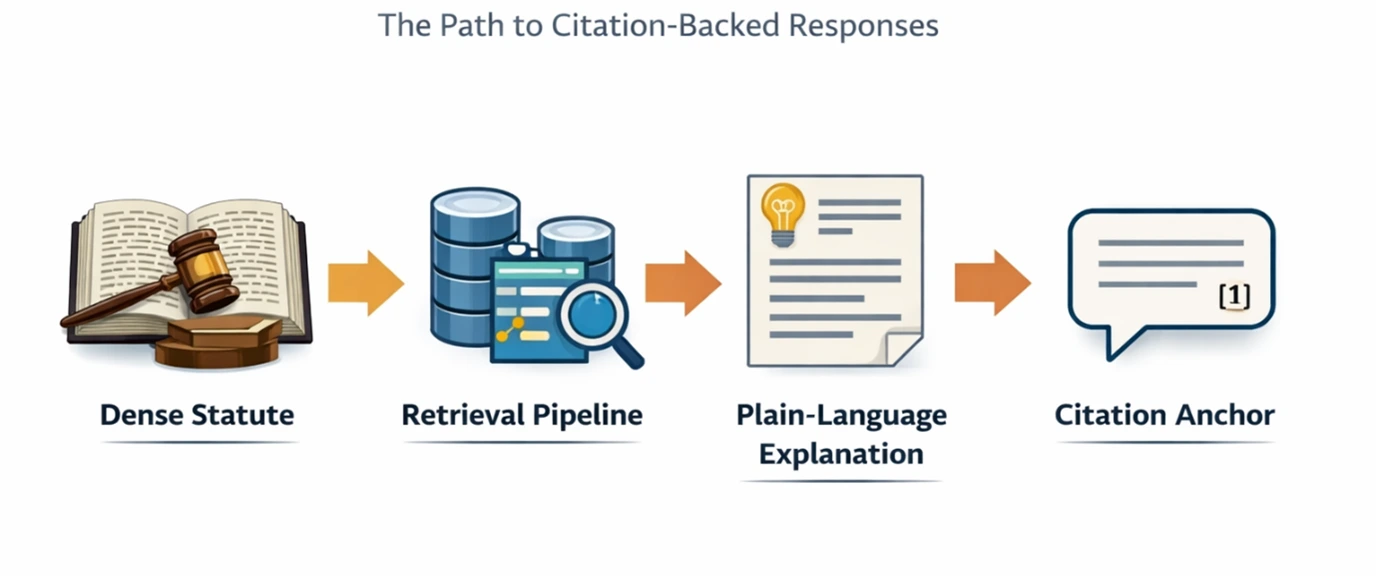
A reliable system must:
- Retrieve relevant source passages from structured document stores
- Normalize citations so sections and subsections are indexed correctly
- Use hybrid semantic and keyword retrieval to reduce omission risk
- Present exact source text alongside plain language explanation
- Preserve version history and authority metadata
Without disciplined ingestion pipelines and metadata indexing, citation is cosmetic. With proper governance controls in place, the infrastructure becomes defensible.
This distinction separates experimental AI from institutional AI.
Plain Language Without Legal Drift
Public institutions increasingly prioritize plain language communication. The intent is correct. Legal text is inaccessible to most stakeholders.
But simplification introduces danger. The qualifiers disappear, exceptions are omitted, and time conditions get lost.
Citation-backed AI solves this by layering explanation over source authority.
Instead of:
“The agency must file within 30 days.”
Citation-backed AI provides:
“A report must be filed within 30 days when the X condition applies. This requirement is defined in Section 4(b)(ii) of the Administrative Code.”
The user can immediately verify the source. The explanation becomes transparent rather than interpretive guesswork.
Impact Across Core Audiences
- Government agencies: Faster internal policy analysis, consistent public guidance, and reduced reliance on senior experts.
- Law firms & lobby firms: Accelerated legislative review with source accountability and stronger client advisory workflows.
- Legal nonprofits: Clearer community education and advocacy grounded in traceable interpretation rather than paraphrased summaries.
In each case, the value is not just speed. It reduces interpretive risk.
Beyond Legislation: A Pattern for Any Dense Corpus
The same model applies wherever dense documentation intersects with accountability requirements.
- Compliance manuals
- Procurement policies
- Human resources handbooks
- Standard operating procedures
- Healthcare regulations
- Financial oversight frameworks
Any environment that demands both accessibility and auditability benefits from citation-backed conversational systems.
Citation as Governance, Not a Feature
The most important shift is strategic.
Citation-backed conversational AI is not a productivity enhancement. It is a governance mechanism.
In regulated environments, the question is never simply, “Can AI answer this?” The real question is, “Can we defend this answer if challenged?”
Systems that provide traceable reasoning, version awareness, and explicit source linkage support institutional accountability. Systems that generate untraceable summaries are excluded.
Public trust depends on clarity. Institutional resilience depends on defensibility.
When conversational AI is built on disciplined retrieval and citation governance, it does not replace legal expertise. It augments it with structured transparency.
In environments where accuracy shapes public confidence, conversational AI cannot be opaque. It must be traceable, auditable, and defensible.
Anything less is not transformation. It is risk.
See How This Works in Practice
Most teams know AI creates risk. Few know how to fix it.
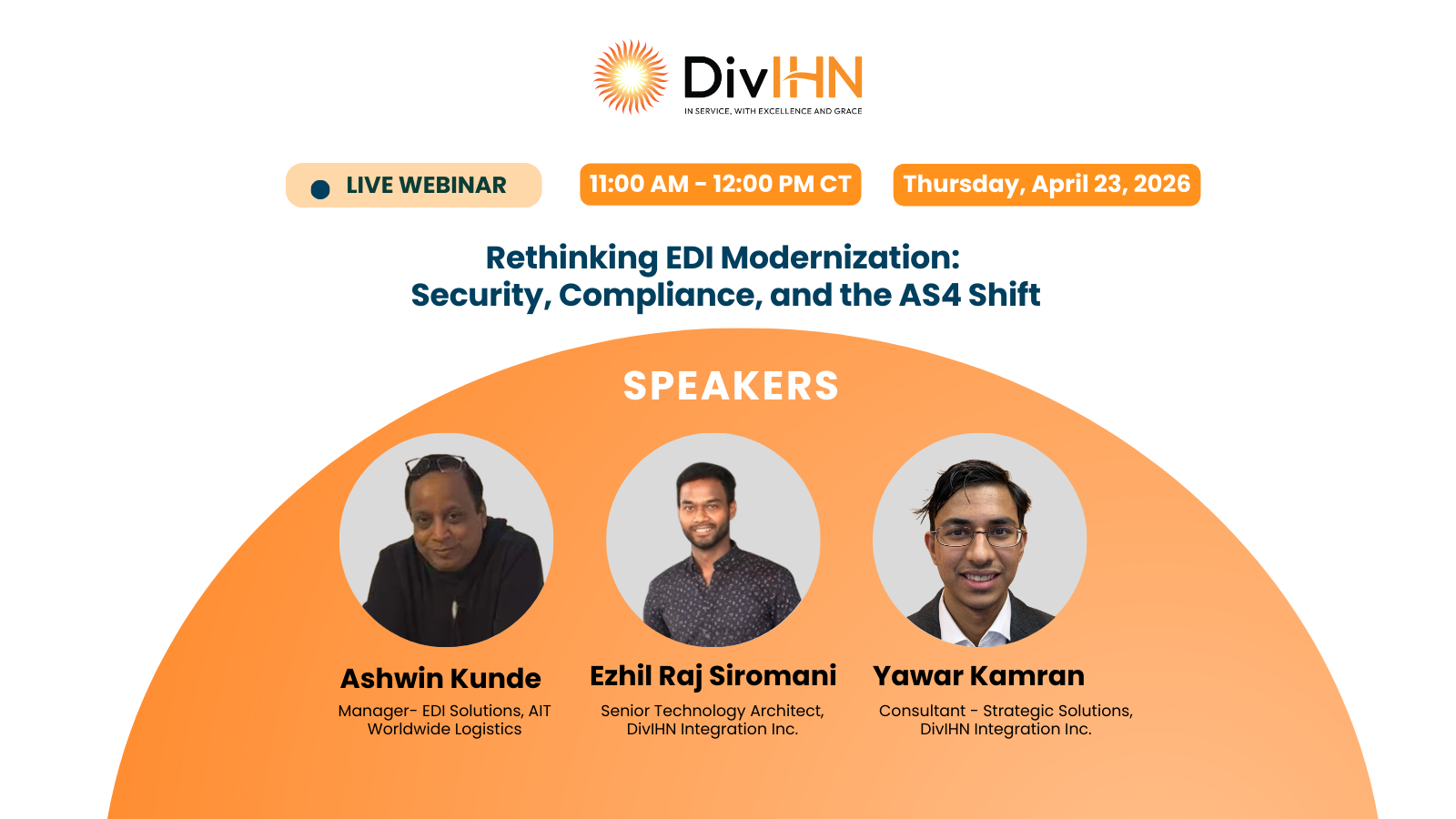
Our upcoming webinar breaks down how citation-backed systems work in real legal and policy environments.
Reserve your seat: How Conversational AI is Changing Legal Research and Analysis


Popular Articles
In the digital age, businesses must adopt an ad
GRC is the capability, or integrated collection
Get the latest insights straight from our desk to your inbox.
Featured Articles
Explore more →
Whitepaper: Ransomware Threat Management
Ransomware continues to be a real threat to business operations across all industries, no organization is safe from this threat.
Laszlo S. Gonc
CISSP, First Senior Fellow, DivIHN Cybersecurity Center of Excellence view
Cybersecurity Incident Response Preparedness
An incident response framework provides a structure to support incident response operations. A framework typically provides guidance on what needs to be done, but not on how it is done.
Laszlo S. Gonc
CISSP, First Senior Fellow, DivIHN Cybersecurity Center of Excellence view
IoT Medical Device Cybersecurity
Healthcare data and medical devices would be aggressively targeted by ransomware attacks since early 2017 has proven to be true